
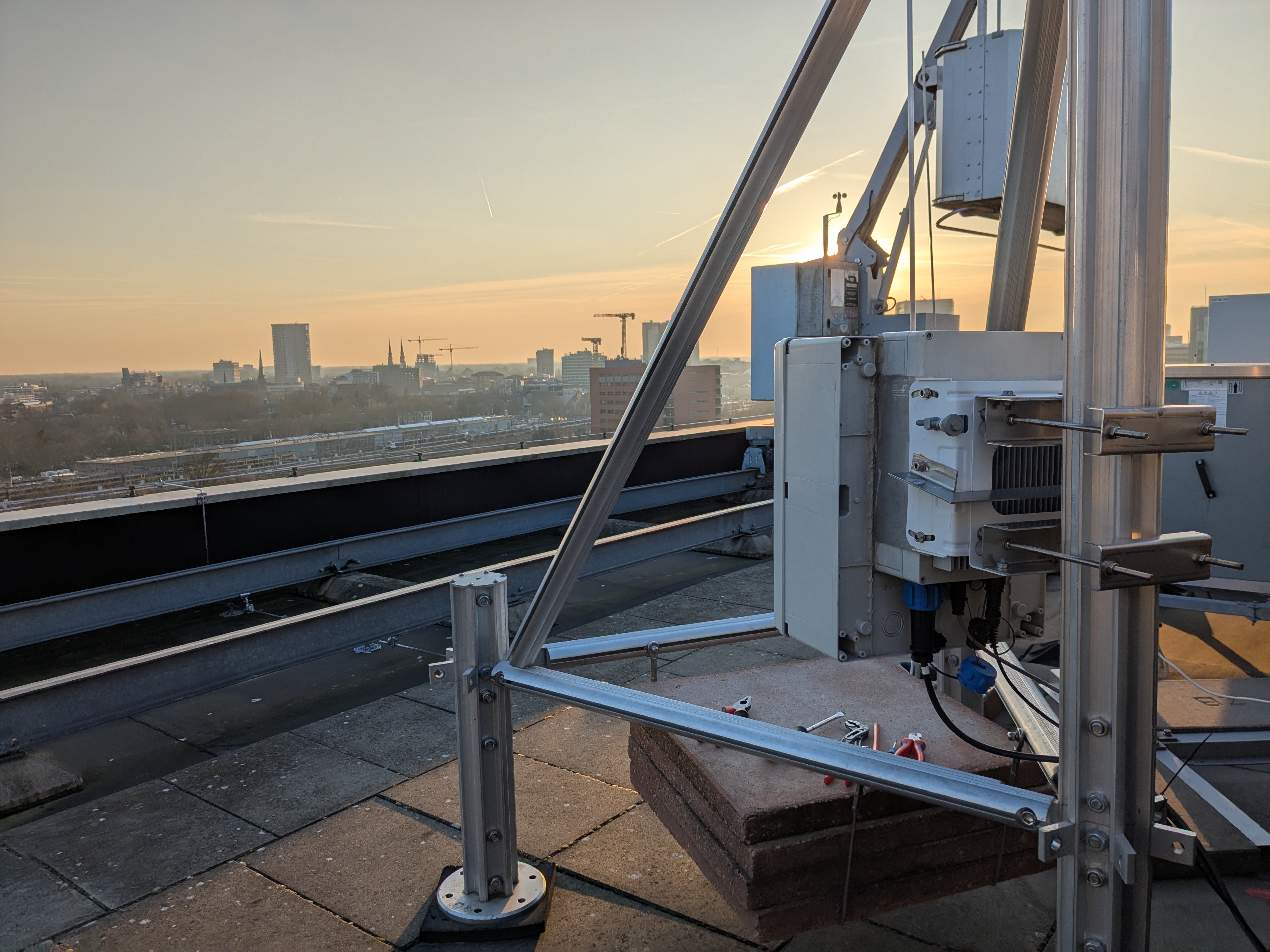
Free-space optical (FSO) technology has grown from a 19th-century experiment into a wireless link that moves terabits of data through the air. In 1985, the first commercial FSO systems carried up to 34 Mb/s. In October 2024, a link across the city of Eindhoven carried 5.7 Tb/s over 4.6 km. That is more than 160,000 times more capacity in under four decades.
At Aircision, we have helped write a large part of that story from our base at High Tech Campus Eindhoven. In this article, we trace how FSO grew, what is pushing it forward today and where it goes next.
In short: FSO technology is growing because radio spectrum is congested, demand for capacity keeps rising and optical links deliver fibre-like speeds through the air without cables or spectrum licenses. Data rates have climbed from megabits in the 1980s to multiple terabits per second today, and analysts forecast the FSO market to grow by around 30% per year until 2030.
What is FSO technology?
FSO is a wireless communication technology that sends data on a narrow beam of infrared light between two points with a clear line of sight. A transmitter shapes and aims the modulated laser light, the beam travels through the air, and a receiver focuses it onto a photodetector that turns it back into data. Because it uses light instead of radio, FSO operates in unlicensed spectrum and offers far more bandwidth than radio links. New to the topic? Start with our guide What is Free-Space Optics?.
How has FSO technology grown over time?
FSO grew in three waves: early proofs of concept, commercial megabit and gigabit links, and today's coherent terabit systems. The table below shows the key milestones.
- Wave 1: Proof of concept (1880 to the 1970s)
In 1880, Alexander Graham Bell's photophone carried a voice on reflected sunlight to a selenium receiver. It was never widely used, but it proved that light can carry information through open air. The invention of the laser and NASA's laser communication experiments in the 1960s turned that idea into an engineering discipline, as the peer-reviewed history of FSO in Encyclopedia (MDPI) describes.
- Wave 2: Commercial links (1985 to the 2010s)
The first commercial FSO systems appeared in 1985 with capacities between 100 kb/s and 34Mb/s. By 1999, links reached 100 to 155 Mb/s, and soon after 622 Mb/s. By 2020, systems with capacities of up to 100 Gb/s had been reported. These links connected office buildings, mobile base stations and temporary sites where laying fibre was too slow or too expensive.
- Wave 3: The terabit era (2020s)
The biggest leap came when FSO borrowed proven techniques from fibre optics: coherent modulation and wavelength division multiplexing (WDM), which sends many wavelengths through one beam at the same time. In 2023, we demonstrated 1.2Tb/s over a 1.7 km link together with Instituto de Telecomunicações. In October 2024, researchers from Eindhoven University of Technology (TU/e) transmitted 5.7 Tb/s over 4.6 km using Aircision's optical antennas, combining 22 WDM channels across a 1.1 THz wide signal (van Vlietet al., OFC 2025).
The jump from 2021 to 2024 stands out. In three years, our field links went from 10 Gb/s to the 5.7 Tb/s that TU/e transmitted across Eindhoven: a 570-fold increase. You can follow every step on our journey timeline.
Why is FSO technology growing now?
Four forces are driving FSO from niche to mainstream infrastructure.
- Radio spectrum is crowded and expensive
Radio frequencies are licensed, congested and limited in bandwidth. Infrared communication offers more than 100 times the bandwidth of 5G or Wi-Fi, needs no spectrum license and does not interfere with neighbouring links. Because each beam is so narrow, many links can run side by side on the same rooftop.
- The connectivity gap is still wide
According to the ITU's Facts and Figures 2025, 2.2 billion people remain offline, and 96% of them live in low- and middle-income countries. Trenching fibre to every remote town is slow and costly. FSO cancarry fiber-class capacity over several kilometers in hours, bridging rivers, roads and terrain where cables cannot go.
- 5G and 6G need more backhaul capacity
The ITU estimates that 5G now accounts for around 3 billion subscriptions worldwide. Every new small cell and base station needs a high-capacity link back to the core network. Terabit FSO gives operators a wireless backhaul option that scales with demand, which is why we see it as a building block for 6G.
- Security and resilience matter more than ever
A narrow infrared beam is extremely hard to intercept and cannot be jammed by radio interference. That makes FSO attractive for defense, critical infrastructure and disaster recovery, where a network must stand up quickly and stay private. We explore this in more depth in Why Companies Are Investing in Free-Space Optics.
How big is the FSO market?
VynZ Research forecasts that the global free-space optics market will grow at a compound annual growth rate of about 30% between 2025 and 2030, reaching 1.9 billion US dollars by 2030, up from 550 million US dollars in 2023 (as reported by Laser Focus World). Forecasts differ between research firms, but they agree on the direction: strong double-digit growth driven by backhaul, last-mile connectivity and secure communications.
How has Aircision contributed to the growth of FSO?
We were founded in 2019 as a spin-off of TNO, with one goal: bring high-capacity optical wireless links from the lab into real networks. Our first field link in 2021 delivered 10 Gb/s over 1 km on an active military base in Oirschot. In 2022, we ran a full-duplex 10 Gb/s link over 6.1 km in Prague. In 2023, we scaled our optical head to 1.2 Tb/s. In 2024, TU/e used our optical antennas to set the 5.7 Tb/s record over 4.6 km across Eindhoven, on a permanent testbed connecting the TU/e campus with High Tech Campus Eindhoven.
"This demonstration of 5.7 terabits per second, between two technology hubs in Eindhoven, highlights the potential of our technology to deliver ultra-high-speed connectivity. We are transforming how data moves through the air, with the aim to make high-speed internet accessible to millions of people faster than ever before."
Luis Oliveira, co-founder and CEO of Aircision
"Because the transmitted infrared light is highly directional, an almost unlimited number of communication links can exist in parallel without interference, allowing wireless network capacity growth at an unprecedented scale."
Vincent van Vliet, researcher at TU/e
The work continues. In 2025, we tested hybrid FSO and microwave links in Eindhoven with Future Network Services, and our optical link connected a satellite to a LiFi network in a test with the Optical Communication Alliance.
What still limits FSO growth?
Weather is the main challenge. Dense fog scatters infrared light and can interrupt a link, while heavy rain and snow weaken the signal. FSO also needs a clear line of sight, and buildings sway in the wind, which can move the beam off target.
The industry is closing these gaps quickly. Automated tracking and pointing keeps the beam locked on the receiver; the terminals on the Eindhoven testbed continuously optimize how the beam couples back into fibre. Wavelengths around 1550 nm allow more transmit power while staying eye-safe. Hybrid systems pair FSO with microwave, so data keeps flowing when visibility drops. FSO is not meant to replace fibre, but to extend it, as we explain in Why Optical Communication Will Complement, Not Replace, Fibre.
What comes next for FSO technology?
Three developments will shape the next phase of growth. First, integrated photonics will make terminals smaller, more energy efficient and cheaper to produce at volume; Bits & Chips reported on our second-generation plans. Second, hybrid optical and radio networks will become a standard design pattern for 6G backhaul. Third, optical links are moving into space: NASA's Deep Space Optical Communications demo downlinked data at 267 Mb/s from about 31 million km away (NASA), proving that light can carry high data rates across enormous distances.
On the ground, permanent testbeds such as the one across Eindhoven let researchers study the urban atmosphere year round and improve reliability in all weather. Every dataset brings terrestrial FSO closer to carrier-grade availability.
FSO has grown more than 160,000-fold since its first commercial systems, and the curve is still pointing up. Want to see what terabit-class optical wireless can do for your network? Explore our technology or talk to our team.