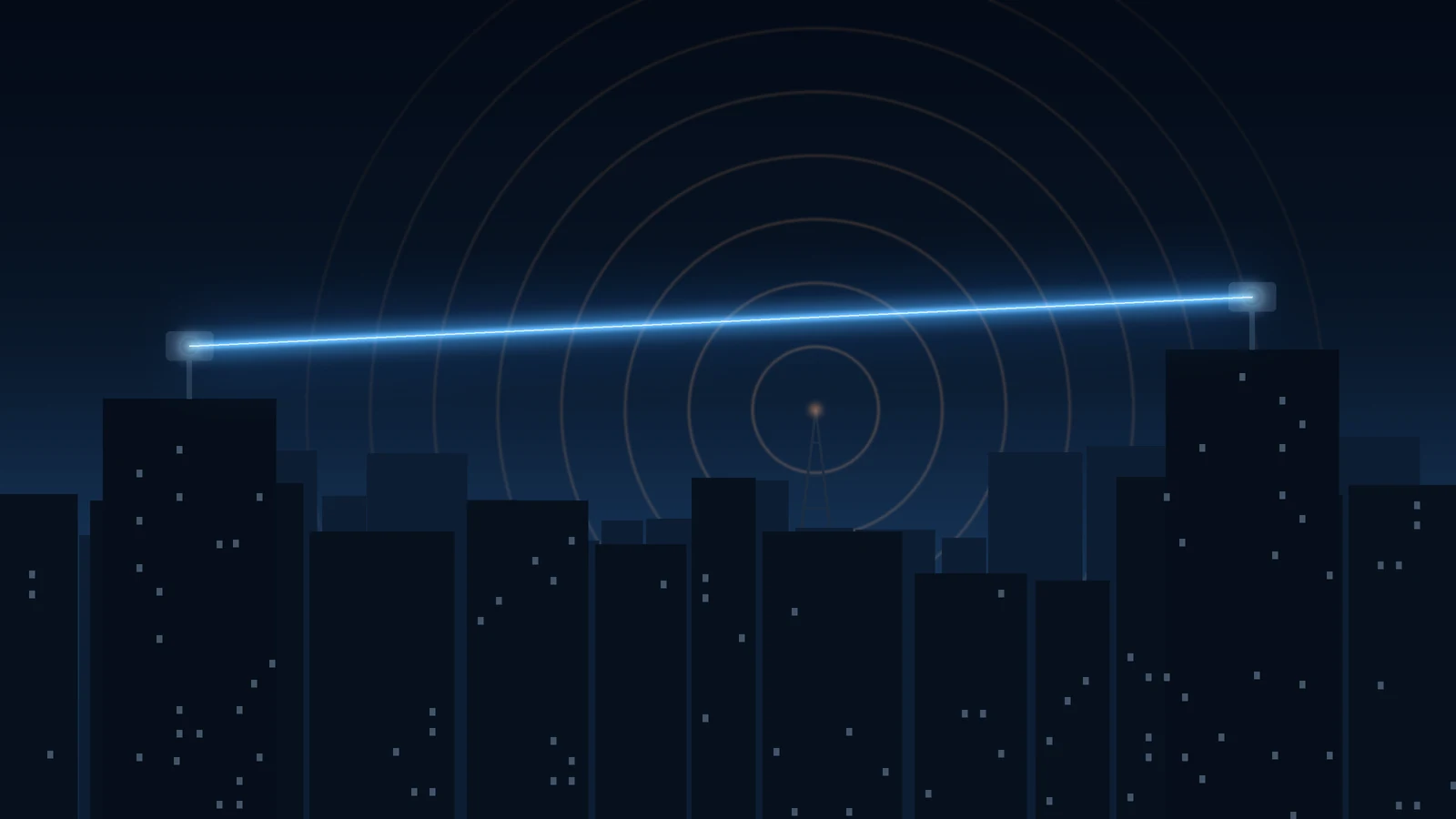

Quick Summary: Free-space optics (FSO) sends data on a narrow beam of infrared light through the air between two points. Compared with traditional networks, FSO offers fiber-class capacity without trenching, needs no spectrum license unlike most radio links, and is very hard to intercept. Its main limit is dense fog, which is why FSO works best alongside fiber and radio rather than instead of them.
Every network has to answer the same question: how do you move data from A to B? For decades there have been two answers. Lay a cable in the ground, or send radio waves through the air. At Aircision we work on a third answer: light through the air.
Free-space optics is not here to replace the networks we already rely on. It is here to close the gaps they leave behind. In this article we compare FSO with fiber, microwave and milli meter-wave radio, and copper on the factors that matter when you plan a link: capacity, deployment, licensing, security and weather. We are also honest about where FSO is not the right choice.
What are traditional networks?
When we talk about traditional networks, we mean the three technologies that carry most of today's data between sites.
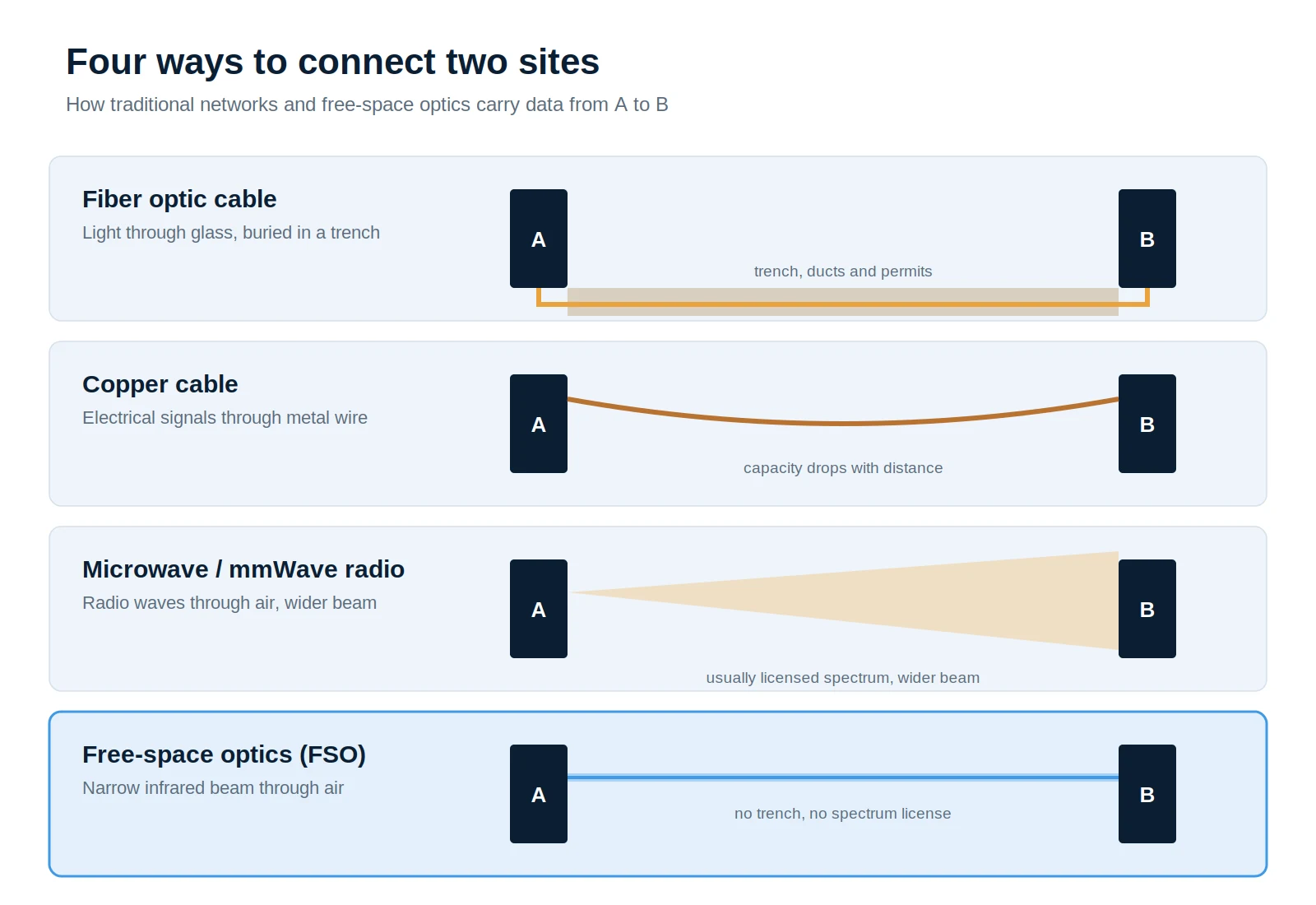
- Fiber optic cable guides light through strands of glass. It forms the backbone of the internet and offers the highest capacity of any medium, but it has to be physically installed, usually in trenches and ducts.
- Copper cable carries electrical signals over twisted pair or coaxial lines. It still connects many homes and businesses, but its capacity drops as distance grows.
- Microwave and milli meter-wave radio send data through the air between antennas on masts and rooftops. Radio links are quick to install and widely used for mobile backhaul, but most bands require a spectrum license and the available bandwidth is limited.
How does free-space optics work?
FSO sends data on a modulated laser beam through the air between two terminals in line of sight. The transmitter focuses the light into a narrow beam; the receiver collects it with optics and converts it back into an electrical signal. Modern systems typically work in the near-infrared, often at 1550 nm. That is the same wavelength used in fiber networks, so an FSO link connects naturally to existing fiber equipment. Think of it as fiber without the cable.
Because FSO uses light instead of radio waves, it operates in spectrum that needs no license. And because the beam is so narrow, many links can run side by side without interfering with each other. New to the technology? Start with our guide What is Free Space Optics?.
FSO vs fiber: the question is where, not which
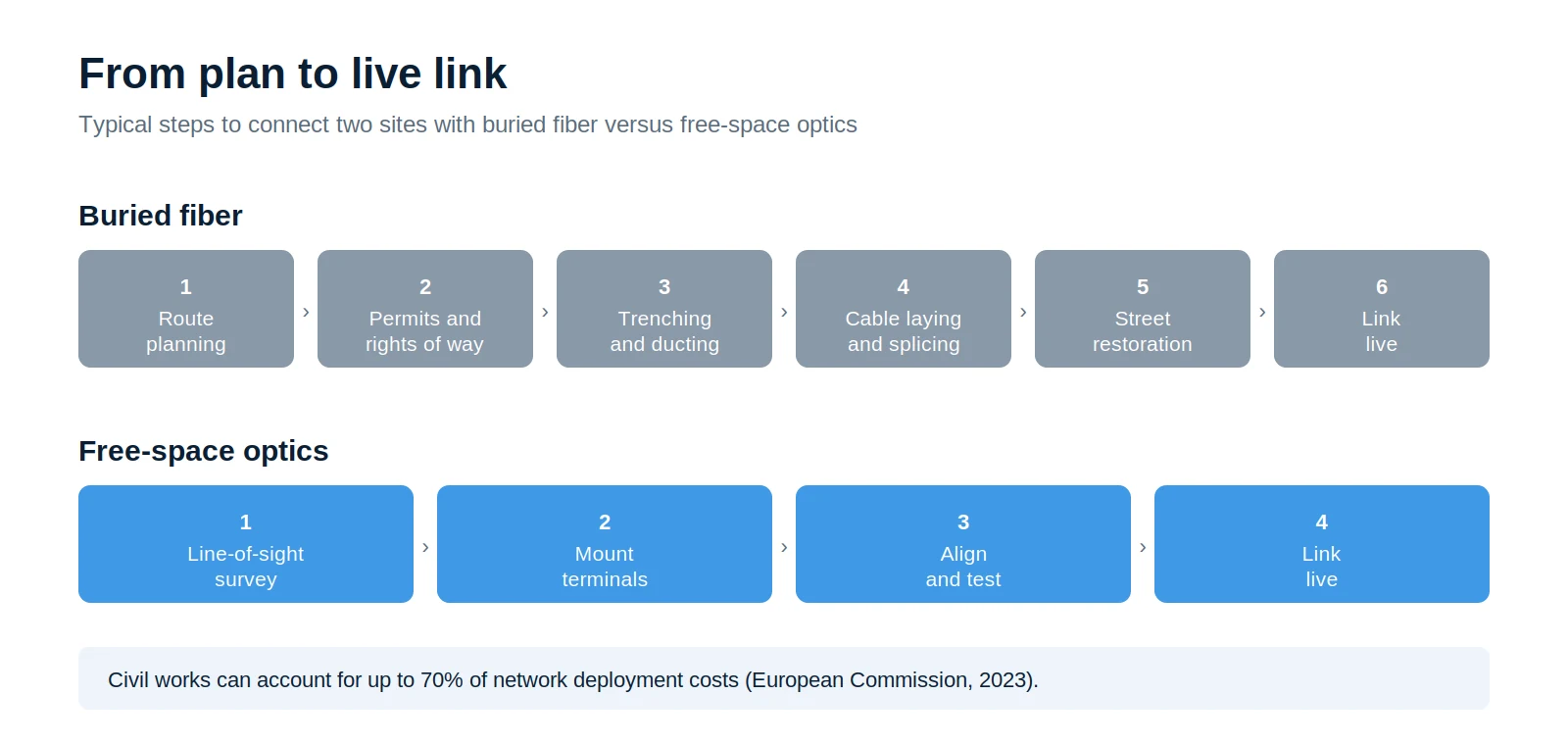
Fiber is the gold standard for permanent, long-distance capacity, and nothing in this comparison changes that. The challenge with fiber is getting it into the ground. According to the European Commission, civil works such as digging trenches and laying ducts represent up to 70% of the costs of network deployment. That is one of the main reasons the EU introduced the Gigabit Infrastructure Act, to cut permitting delays and coordinate works between operators.
FSO skips the trench. Terminals mount on rooftops, masts or towers, so a link can cross a river, railway, motorway or protected historic district without opening the ground. That makes FSO a natural fit for the last stretch of a network, for building-to-building links and for routes where fiber is slow, costly or simply not permitted.
There is a physics advantage too. Light travels roughly a third slower in glass than in air, and a fiber route rarely follows a straight line. An FSO beam takes the most direct path between two points, which helps keep latency low. We explore this relationship in more depth in Why Optical Communication Will Complement, Not Replace, Fiber.
FSO vs microwave and millimeter-wave radio
Radio links and FSO links look similar on a map: both connect two points through the air inline of sight. The difference is the spectrum they use.
Radio spectrum is crowded and regulated. Most microwave bands require a license, and in dense cities the frequencies are increasingly saturated. Optical frequencies are far higher, which gives FSO much more bandwidth to work with and no license to apply for. In 2023 Aircision demonstrated 1.2 Tbps over a 1.7 km optical wireless link using coherent modulation and wavelength division multiplexing. According to our measurements, that is over 80 times more data than a state-of-the-art radio frequency system delivers today.
Beam width matters as well. A radio link spreads its energy in a wider cone, which can interfere with neighboring links and makes the signal easier to detect. An FSO beam is so narrow that there is almost no practical limit to how many separate links can operate in one location.
Radio does have one clear advantage: it copes better with fog. We cover that below, and it is exactly why the two technologies work so well together.
FSO vs copper
Copper served networks well for over a century, but it was never designed for today's data volumes. Its capacity falls as cable length increases, and upgrading usually means replacing the cable, with all the civil works that involves. European policy is moving the same way: under the new rules, new and majorly renovated buildings should be equipped with fiber. For sites still on copper, FSO offers a route to fiber-class capacity without waiting for new cable to arrive.
What about the weather?
This is the question we hear most often about FSO, and it deserves a straight answer.
Rain has a modest effect on optical links. Published research puts the loss at roughly 1to 10 dB per kilometer, from light to heavy rain, at the wavelengths FSO uses. Dense fog is different. When visibility drops below about 50 meters, attenuation can exceed 350 dB per kilometer, which is enough to interrupt a longer link.
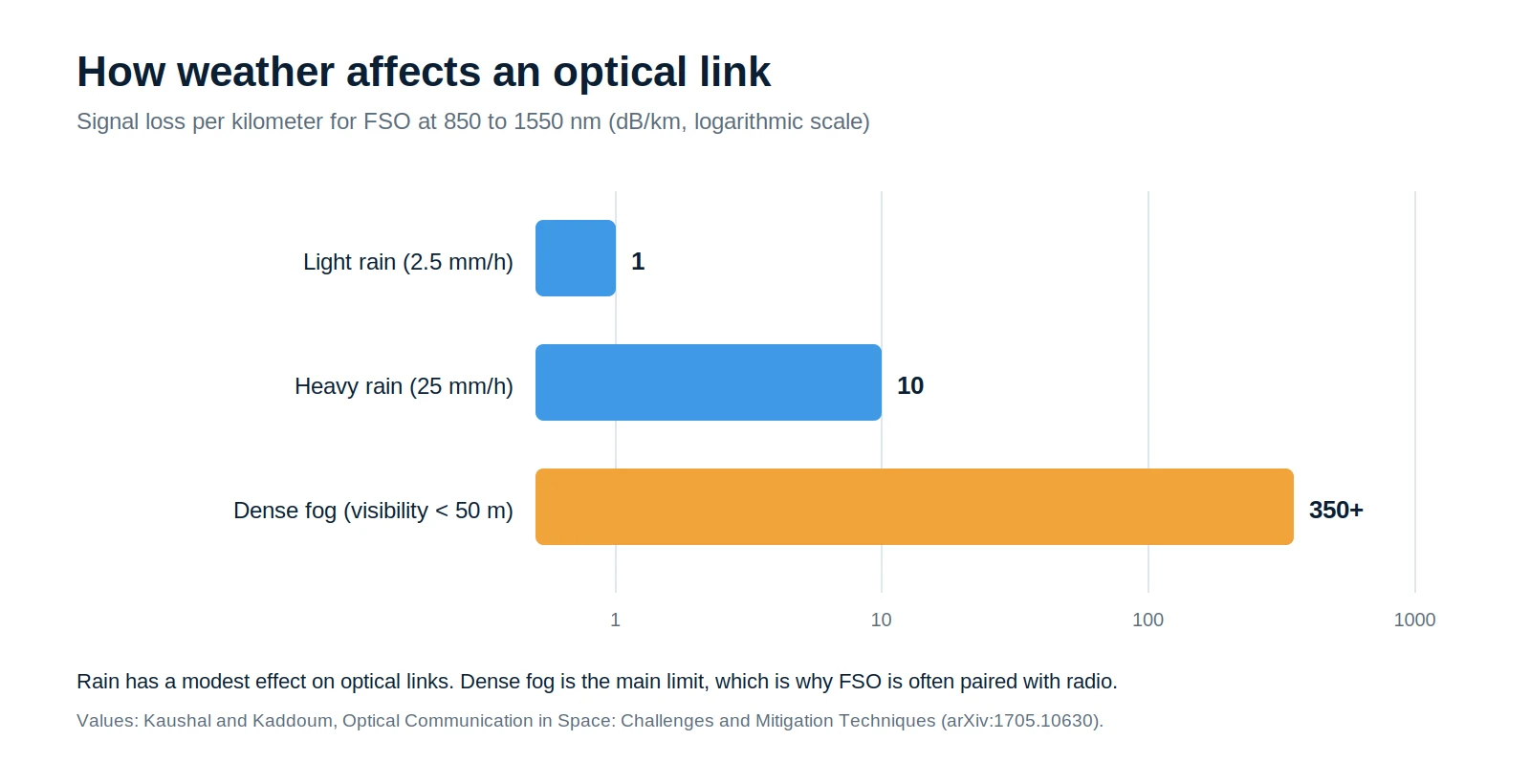
For radio the picture is largely reversed. Rain is the main enemy of radio links, especially at higher frequencies, while fog affects them far less. That is why the most resilient networks combine both.
Engineers manage weather risk in several ways: by designing links with enough margin, by using shorter hops in fog-prone regions, by pairing FSO with radio in a hybrid link, and by using beam tracking to hold alignment as buildings move and air temperature changes. In Eindhoven, the Reid Photonloop testbed between the TU/e campus and High Tech Campus is used to study how the urban atmosphere affects optical links in all types of weather.
Security: why a beam of light is hard to tap
Security is where FSO stands out against every wireless alternative. The beam is narrow and invisible to the naked eye, and it cannot be picked up with radio spectrum analyzers or RF meters. To intercept the data, someone would have to place equipment directly in the beam path, which disrupts the signal and can be detected. Combined with encryption, this makes FSO well suited to sensitive links in government, finance, healthcare and defense.
The bottom line
FSO versus traditional networks is not a contest with one winner. Fiber remains the backbone. Radio remains the most fog-tolerant way to cross the air. FSO adds what neither can do alone: fiber-class capacity through the air, without trenches or spectrum licenses, deployed where and when it is needed.
That matters. According to the ITU, 2.2 billion people were still offline in2025, and only 58% of people in rural areas use the internet, compared with 85%in urban areas. Closing that gap will take every tool available, and light through the air is one of the fastest.
Planning a link and wondering which technology fits? Talk to our team.