
What is free space optics?
Short answer. Free space optics (FSO), also called free-space optical communication or FSOC, sends data as a beam of laser light through the atmosphere instead of through a fibre-optic cable or over licensed radio spectrum. Two transceivers with a clear line of sight exchange data at fibre-grade speeds, with no trenching and no spectrum licence.
Free space optics sounds complicated. The idea behind it is not.
Instead of pushing light down a glass fibre or a signal over radio frequencies, FSO points a laser beam directly at a receiver kilometres away and rides data on that light. Where fibre cannot be trenched in time, or radio cannot carry enough capacity, a laser link can be installed and carrying traffic within hours.
How does free space optics work?
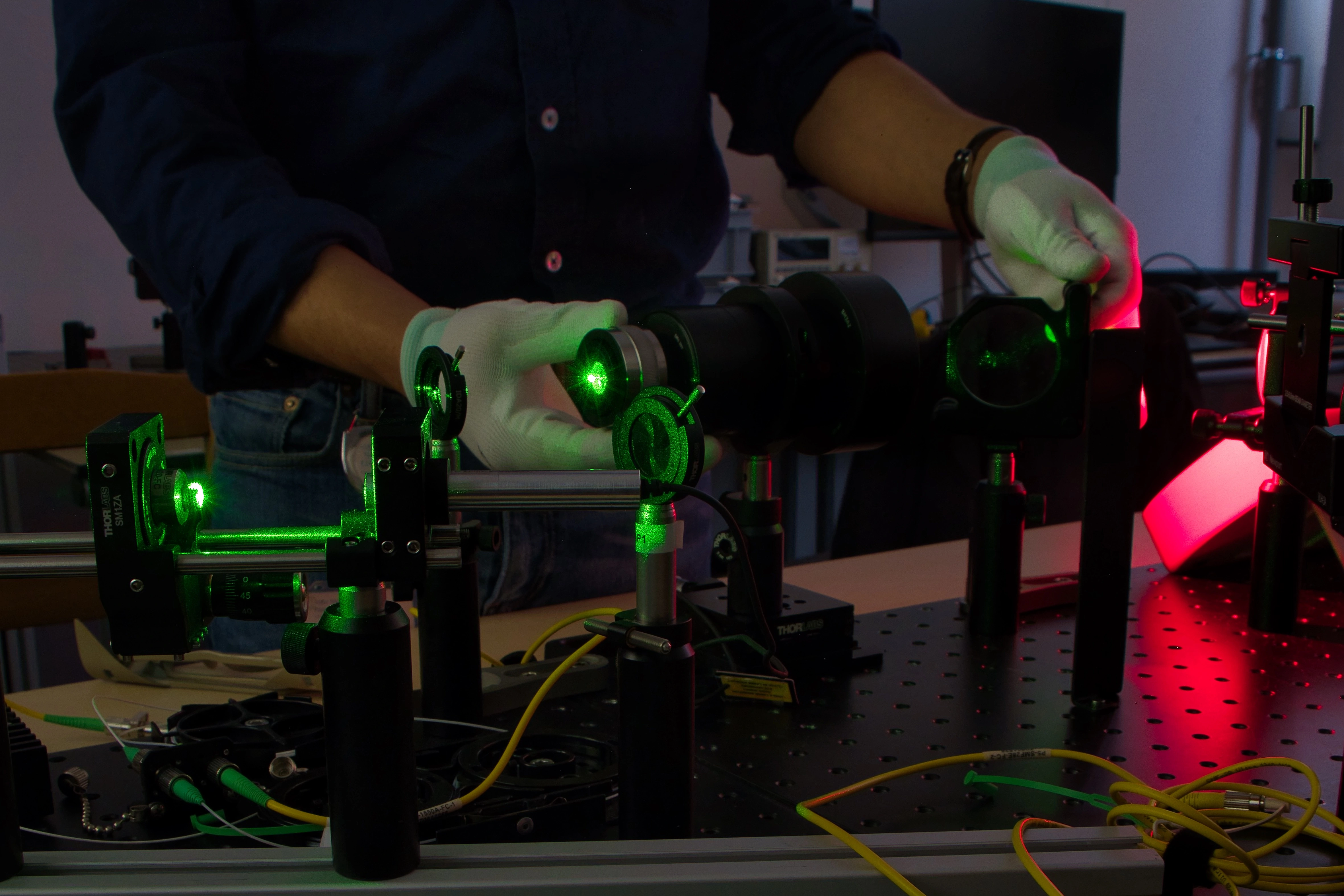
An FSO link has two ends, and each end has both a transmitter and a receiver:
- A laser diode, usually operating in the near-infrared band (commonly around 850 nm or 1550 nm, chosen for eye safety and low atmospheric absorption), converts an electrical data signal into modulated light.
- The beam travels through open air to a receiver telescope at the other end, which is aligned to the transmitter's line of sight.
- A photodetector converts the received light back into an electrical signal.
- A pointing, acquisition and tracking (PAT) system keeps the beam locked on the receiver, correcting for wind sway, temperature drift and vibration in the supporting structure.
Higher-capacity systems add the same techniques used in long-haul fibre networks: coherent modulation and wavelength division multiplexing (WDM), which carry multiple data streams on different wavelengths of the same beam. That combination is how field trials have pushed FSO from single-digit gigabits per second to multi-terabit throughput over the past few years.
Free space optics compared with fibre and radio
None of this makes FSO a replacement for fibre or radio. It fills the gap between them: capacity closer to fibre, deployed closer to the speed of a radio link.
What limits a free space optics link?
Because FSO depends on a clear line of sight, atmosphere is part of the engineering problem, not a footnote.
Dense fog is the main limiting factor. Water droplets scatter light far more than they scatter radio waves, and heavy fog can attenuate a beam by tens to over a hundred decibels per kilometre. Rain and snow cause smaller losses in most climates. Sunlight adds a different kind of problem: it raises the background noise a receiver has to filter out, which is why link margins are calculated for worst-case daylight conditions, not average ones.
"Our system is more resistant to atmospheric effects, such as fog, and brings incomparable improvement compared with existing FSO technologies," said Dr. John Reid, 2020, describing lab tests with TNO under adverse atmospheric conditions.
System designers manage these limits with link margin (extra transmit power held in reserve for bad weather), wider beams, shorter hop distances in fog-prone regions, and hybrid designs that pair an FSO link with a microwave or RF backup for the rare hours visibility drops below what the optical link can handle.
Where is free space optics used?
- Mobile network backhaul. Connecting 4G and 5G base stations, and future 6G networks, to the core network, especially where fibre would take too long to permit and trench.
- Data centre interconnects. High-capacity, point-to-point links between nearby data centre buildings or campuses.
- Defence and government networks. Point-to-point links that do not need a spectrum licence and are difficult to intercept or jam without breaking line of sight, which matters for tactical and dual-use communications.
- Disaster recovery and temporary events. Restoring or adding high-capacity connectivity in days after infrastructure is damaged or where none exists yet.
- Ports, campuses and last-mile links. Bridging the "last mile" between a fibre point of presence and a building where digging is not practical.
- Disaster recovery and temporary events. Restoring or adding high-capacity connectivity in days after infrastructure is damaged or where none exists yet
Is free space optics secure?
Security is one of the more counterintuitive advantages of FSO, and it follows directly from the physics.
A laser beam travels in a narrow, directional line between two points. Unlike radio, which radiates in every direction from an antenna, an optical beam that never reaches a receiving telescope carries no signal to intercept. To eavesdrop on an FSO link, an adversary has to physically get into the beam path, which typically means breaking the line of sight the two ends depend on. The link itself can detect that. It is a fundamentally different exposure than a radio signal, which can be received well outside the area either end intended.
This is also why free space optics keeps coming up in conversations about jam resistance: a system that is difficult to detect from outside the beam path is, by the same property, difficult to jam without also being obvious about it.
Free space optics is a growing market
One market forecast, from Future Market Insights, values the FSO communication market at USD 1.5 billion in 2026 and projects USD 5.8 billion by 2036, a compound annual growth rate of about 14.5 percent. The same forecast expects telecommunications to remain the largest application segment and terrestrial systems to hold the largest technology share.
The drivers are not one breakthrough but several arriving together: AI workloads pushing more traffic through networks that were not sized for this scale, coherent optical techniques pushing achievable data rates higher across the industry, and new capital building specifically for this category.
For a deeper look at why that capital is moving now, see Why companies are investing in free-space optics
Frequently Asked Questions
Where Aircision fits in
We are Aircision, a European free space optics company and TNO spin-off based in Eindhoven. Our optical antennas carried the 5.7 Tbps transmission over 4.6 km that TU/e researchers achieved across Eindhoven in October 2024, presented at OFC 2025. It is the highest data rate demonstrated in field-deployed free space optics in an urban environment. We work with the Dutch Ministry of Defence, TU/e and the wider European photonics ecosystem.
That research sits behind our two products: Aircision OWL for defence and tactical use (difficult to detect, deployed in 15 minutes, 5 km range), and Aircision BLACK BIRD for telecom backhaul (10 Gbps, no civil works).
If a fibre trench is not fast enough and a radio link is not secure enough, that is the gap our technology, and our team, is built for. Learn more about our free space optics technology or get in touch with our team.