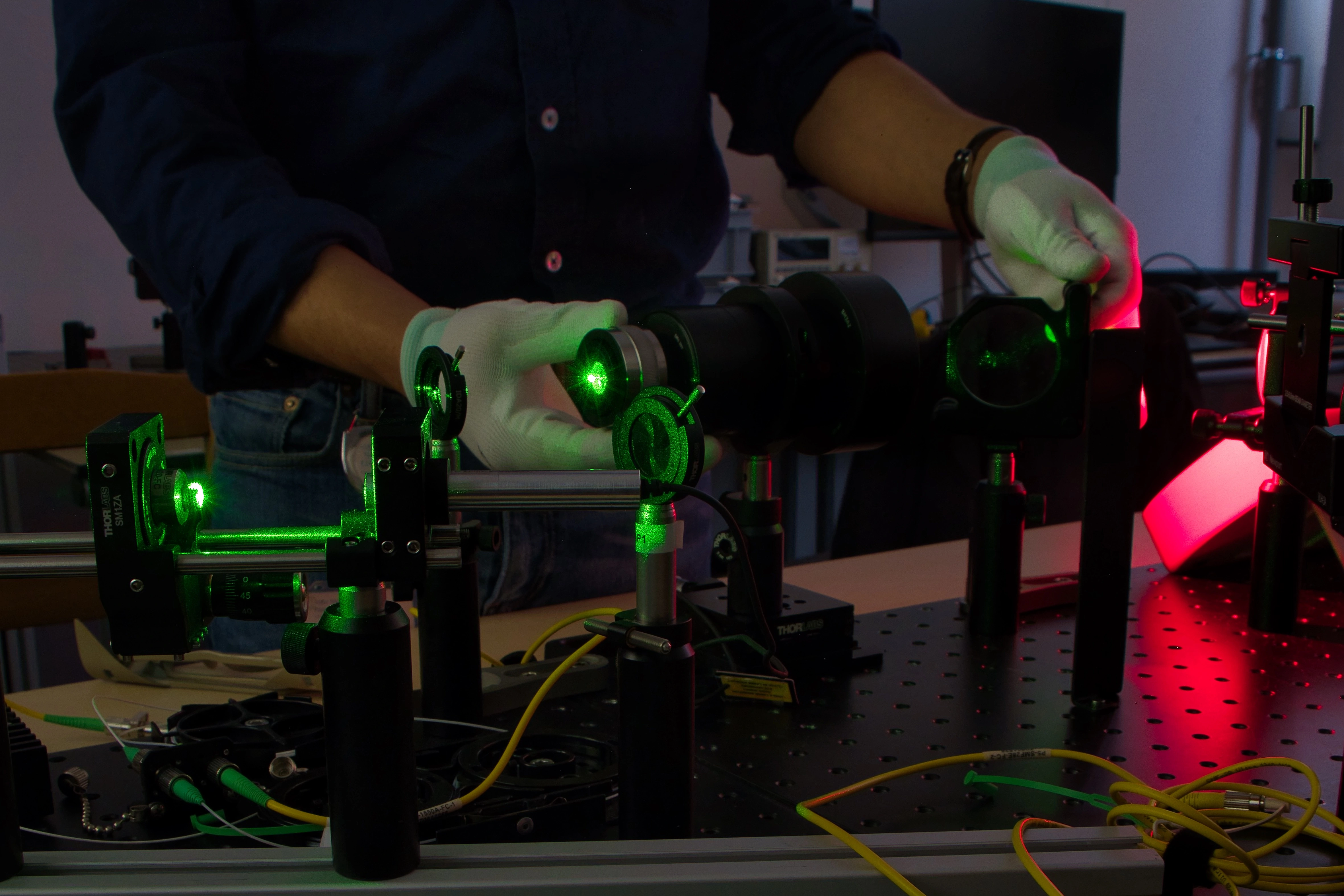

Free-space optics (FSO) is drawing a growing share of telecom and infrastructure capital because it solves a problem fibre and licensed radio spectrum cannot solve fast enough: getting high-capacity connectivity in place in days rather than months or years. Published market forecasts, the underlying physics of optical wireless transmission, and real field results all point the same way. Here is what free-space optics actually is, why the numbers are accelerating, and what the technology still has to work around.
What free-space optics actually is
Free-space optical communication (FSOC) transmits data as modulated laser light through the air between two line-of-sight terminals, the same principle behind fibre-optic transmission, minus the fibre. Systems typically operate at near-infrared wavelengths between 700 and 1600 nanometres, a band chosen because it sits in a part of the spectrum that does not require a licence, unlike the radio and microwave frequencies most wireless networks compete over.
That unlicensed spectrum is a large part of the investment case on its own. An operator deploying an FSO link does not need to bid for scarce frequency allocation or wait on a regulator; the link can be installed and switched on as soon as the two terminals are in place and aligned.
Because the beam is narrow and invisible, it is also inherently difficult to intercept: unlike a radio signal, which spreads out from its source, a laser link has to be physically in the beam's path to be detected at all. That combination, high bandwidth, no spectrum licensing, and a naturally secure transmission path, is why free-space optics keeps coming up as a fibre alternative for defence, telecom backhaul, and enterprise connectivity.
The market is scaling faster than most wireless technologies
The global free-space optics communication market is valued at USD 1.5 billion in 2026 and is projected to reach USD 5.8 billion by 2036, a compound annual growth rate of 14.5 percent, according to Future Market Insights. That grow this being driven by network operators who need high-throughput expansion and backhaul restoration without the cost and delay of trenching fibre or securing scarce, licensed radio spectrum.
Bandwidth demand is outpacing what fibre and RF can deliver quickly
The broader pressure behind the investment numbers is straight forward: data volumes are growing faster than the physical infrastructure built to carry them. Fibre permitting and trenching can take years; licensed radio spectrum is congested and getting more so. As one industry analysis put it, traditional RF and microwave technologies are struggling to keep pace with growing bandwidth and capacity requirements, which is exactly the gap free-space optics is positioned to close: a line-of-sight optical link can be installed in a fraction of the time a fibre trench requires, with no spectrum auction in between.
The physics come with a catch, and it shapes where investment goes
Free-space optics is not without its limits, and the market's own growth depends on solving them. The main technical hurdle is atmospheric attenuation: rain has relatively little effect on an optical link, but dense fog can scatter and absorb enough of the beam to interrupt a connection over longer distances. That single constraint explains most of the current engineering focus in the sector, automated tracking to keep two terminals precisely aligned, shorter link spansin fog-prone regions, and hybrid designs that fall back to a secondary wireless channel if the optical link is temporarily degraded.
Investment is following the systems that treat this as a design problem to engineer around rather than a reason to avoid the technology altogether, which is why reliability and weather performance, not just raw data rate, have become a genuine differentiator in the sector.
Field results are turning the forecast into a funding case
Capital doesn't move on projections alone; it moves once the technology has been proven in the field. In October 2024, researchers from Eindhoven University of Technology (TU/e), working with Aircision's optical antennas, transmitted data at 5.7 terabits per second over a 4.6 km link between the TU/e campus and HighTech Campus Eindhoven, using the Reid Photonloop testbed. It is understood to be the highest data rate demonstrated in a field-deployed free-space optical link in an urban environment, and the result was presented at the Optical Fiber Communications Conference (OFC) 2025 in San Francisco.
"highlights the potential of our technology to deliver ultra-high-speed connectivity" (Luis Oliveira, CEO, Aircision)
Results like this are what turn a market forecast into a funding decision. Every new terabit-scale demonstration makes the case for free-space optics a little harder for network operators, and their investors, to ignore.

Frequently asked questions
What is free-space optics (FSO)?
Free-space optics, also called optical wireless communication, sends data as pulses of laser light through the air instead of over a fibre-optic cable or a licensed radio frequency. It requires a clear line of sight between two points.
Why are companies investing in free-space optics now?
Rising bandwidth demand, congested and costly licensed spectrum, and the time it takes to permit and trench fibre have made the business case for a fast-to-deploy, unlicensed optical alternative harder to ignore. Published market forecasts put the sector on a mid-teens compound annual growth rate through the mid-2030s.
How fast is free-space optics?
Demonstrated speeds vary by system and distance. Aircision and TU/e's Reid Photonloop testbed reached 5.7 terabits per second over 4.6 km in October 2024, one of the highest data rates recorded for a field-deployed FSO link in an urban environment.
Is free-space optics the same as Li-Fi?
No. Li-Fi typically refers to short-range indoor communication over visible light. FSO refers to longer-range, line-of-sight outdoor links, often spanningkilometres, used for telecom backhaul and enterprise connectivity.