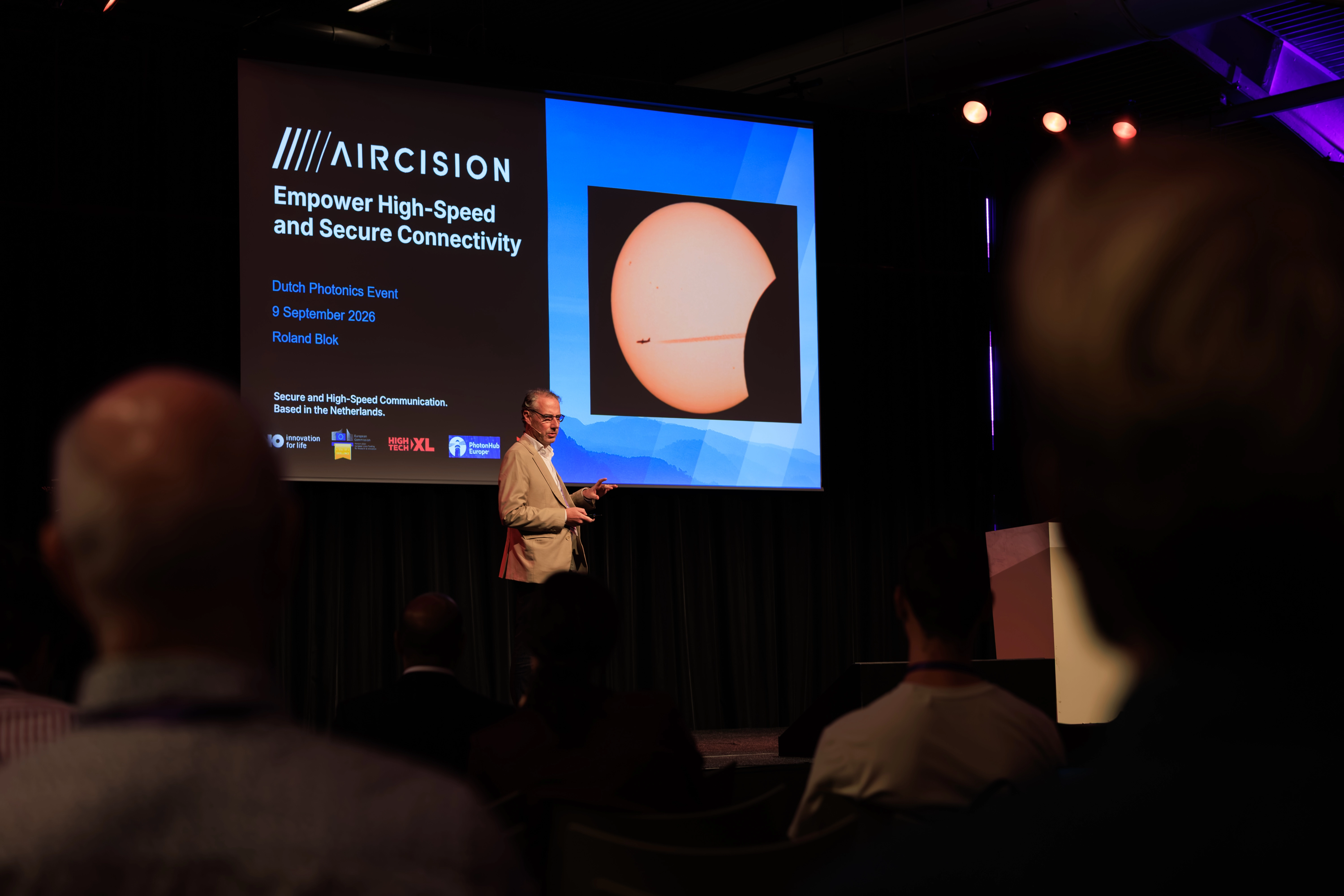
Free-space optics (FSO) sends data through the air on a narrow laser beam. In the lab, it already performs very well. In my experience, that is the easy part. The real work is turning it into links that run outside, over kilometres, in real weather, and that soldiers or network operators can set up themselves. That was the message of my talk at the Dutch Photonics Event 2026 in Den Bosch.
Key takeaways
- FSO links need no spectrum licence and are very hard to detect or jam.
- Our fields links run at Gbps over 1 to 5 km and set up in less than 15 minutes.
- Automatic Alignment, beam tracking and fibre coupling decide whether a link works outside.
- Integrated photonics will be the next step for fibre coupling.
Why do critical networks need an alternative to radio?
Military and critical networks rely mostly on radio. Radio is versatile; it is also broadcast over a wide area, which makes it possible to detect, jam and intercept.
As I said on stage: “Radio is versatile, but it can be detected, jammed and intercepted. Ukraine shows the consequences every day.”
Reporting from the front shows how jamming cuts drone links and overpowers shared frequencies. For networks that must keep running under pressure, a link that is hard to find or disrupt is a strategic advantage.
What does free-space optics add?
FSO carries data on a laser beam through the air, much like fibre carries it through glass. Our field links deliver up to 10 Gbps, need no spectrum licence and can be running over 1 to 5 km in less than 15 minutes. Because the beam is narrow and highly directional, only a receiver placed in its path can pick it up. New to the technology? Our explainer on what free-space optics is covers the basics.
How has free-space optics been proven in the field?
We have built up field evidence step by step, from short links on defence sites to a permanent link that runs every day.
The 10 Gbps links show what a deployable system does today. The terabit results show whatthe optical channel can carry, including the 5.7 Tb/s world record by TU/e researchers using our optical antennas, presented at OFC 2025. The Reid Photon loop link between TU/e and the High Tech Campus Eindhoven now runs with telecom-grade availability.
What does it take to move FSO from record to product?
For me, this is the real step from lab to deployment. A record shows what the physics allows; a product has to deliver it on a rooftop or in a field without a lab engineer next to it. Three things make the difference: automatic alignment, so terminals find each other without manual pointing; beam tracking, so the beam stays on target as masts move and the air shimmers; and good fibre coupling, so the link connects directly to standard network equipment.
For defence, this leads to rapid-deployment systems a team can set up in less than 15 minutes. Weather still sets the limits, with dense fog as the hardest case. That is why long-term field data matters as much as peak data rates.
What comes next for free-space optics?
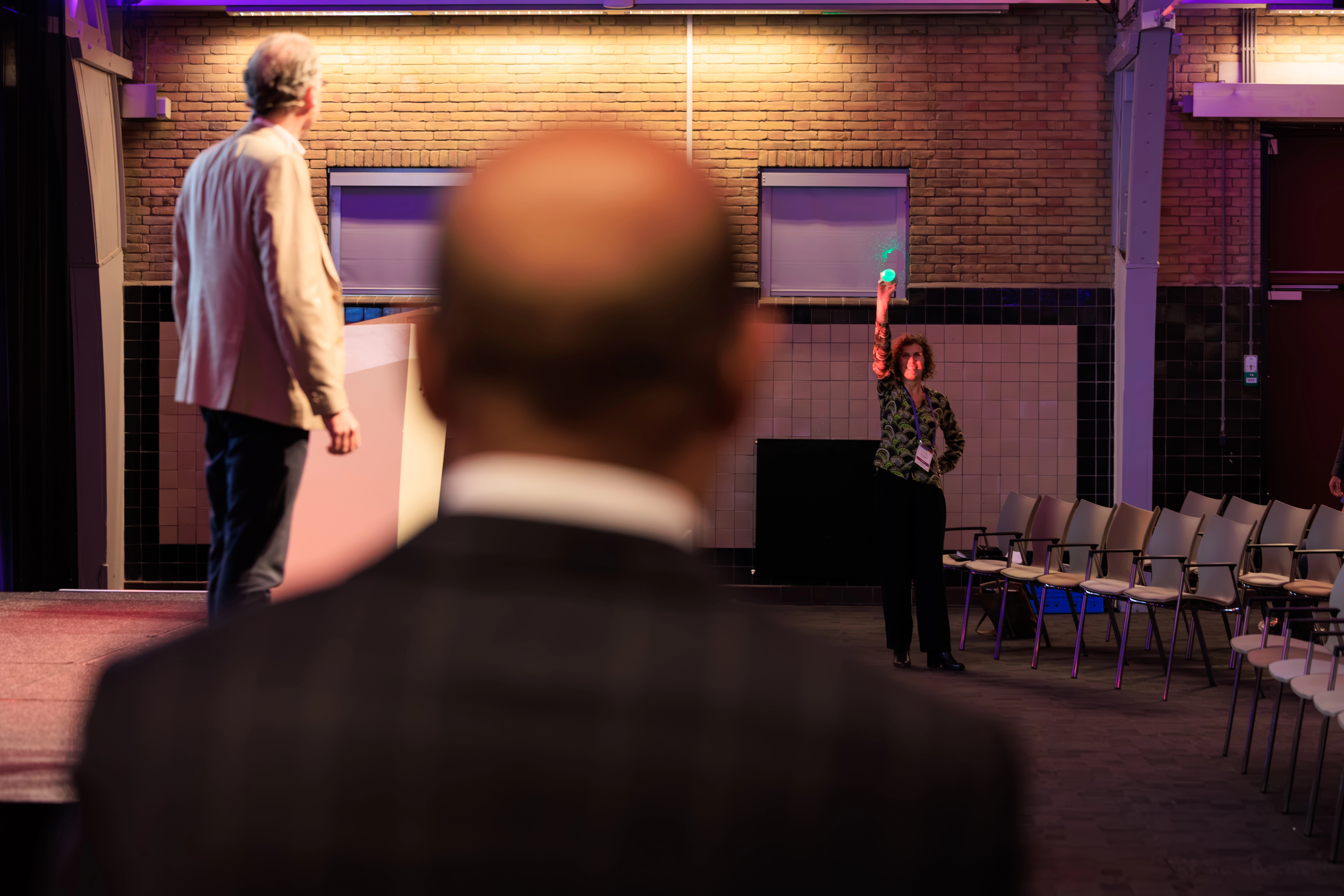
I closed the talk with a look ahead: “Integrated photonics is the future for fibre coupling.”
Photonic chips can replace separate optical components, making terminals smaller, more robust and easier to produce in volume. It is one more way optical wireless will complement fibre, not replace it. Thank you to everyone who joined the session. If you work on resilient networks or integrated photonics, I am happy to continue the conversation.
About Aircision
Aircision is an Eindhoven-based TNO spin-off developing free-space optical communication systems. We work with the Dutch Ministry of Defence in the Optical Communication Alliance, and our approach is dual use.