
Why radio signals are easy to find
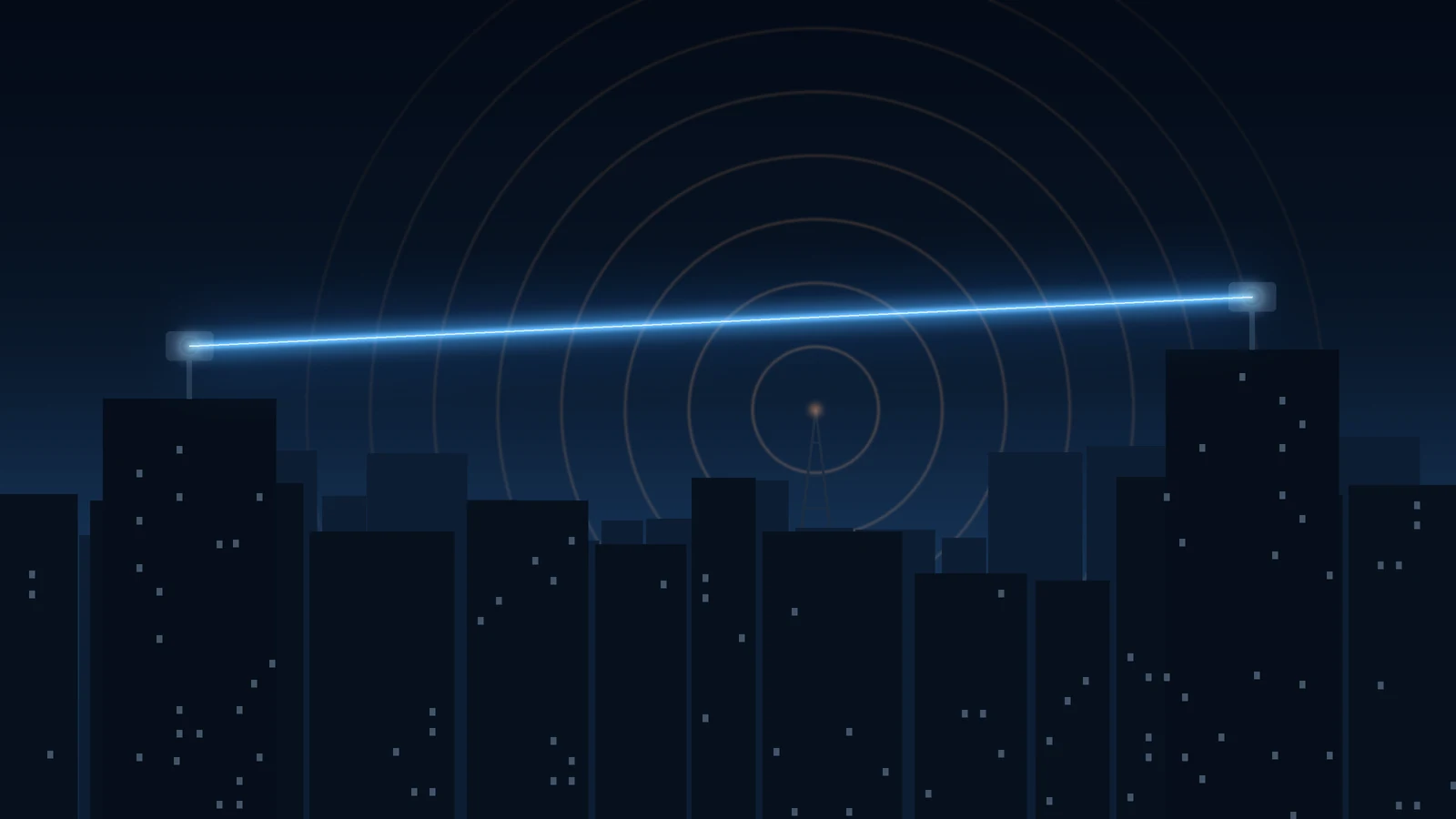
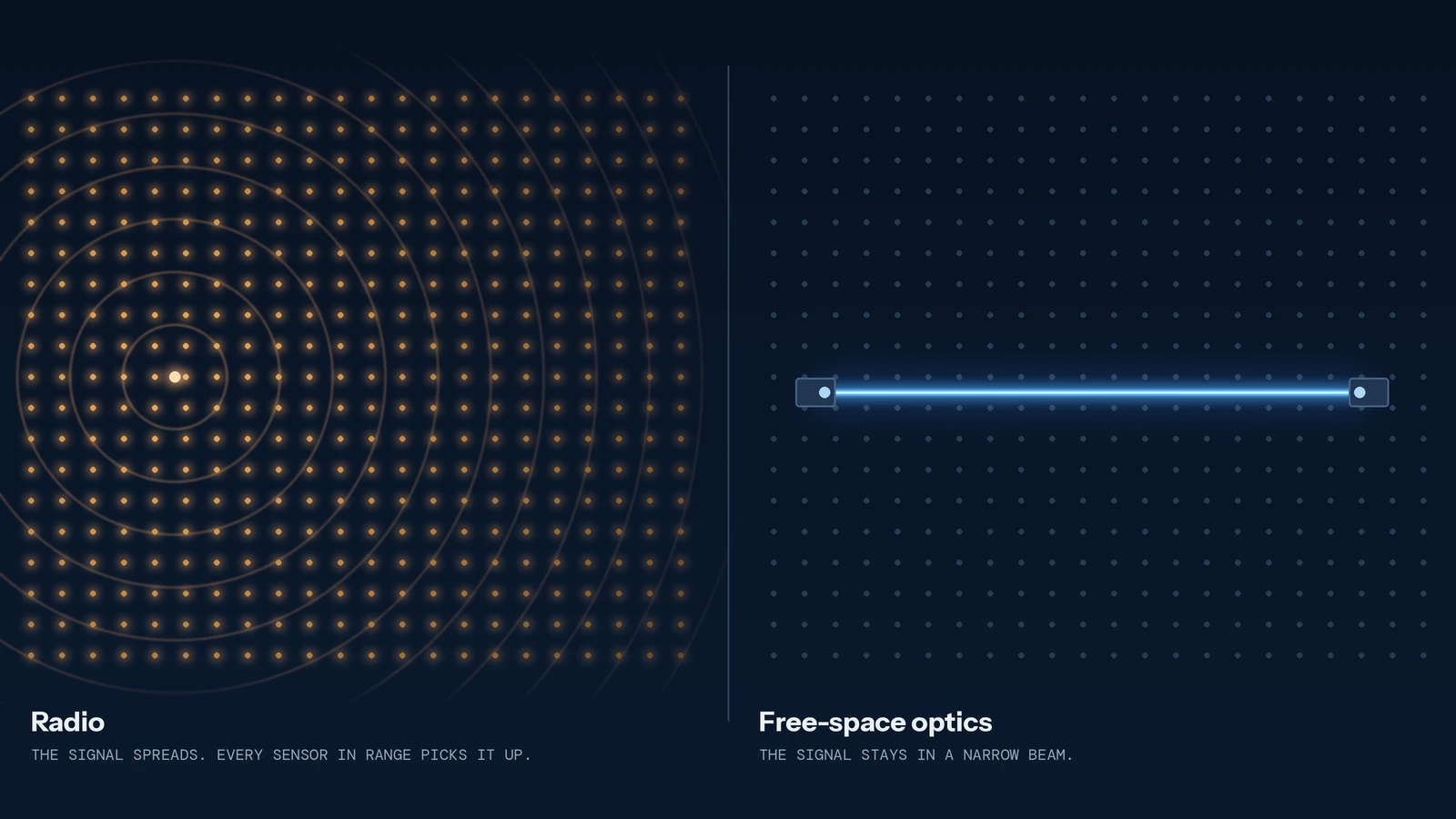
Every radio transmitter spread sits signal over a wide area. That is useful for coverage, and it is also a weakness. Anyone within range with the right receiver can pick up the signal, work out where it comes from and, if they want to, jam it.
The war in Ukraine has made this very concrete. In its study of the first months of the war, it was found that electronic warfare was the main way to counter drones, as the radio emissions of drones and their ground stations can be detected and disrupted.
How a laser link keeps its signal to itself
Free-space optics works differently. It sends data on a laser beam between two terminals with a clear line of sight. Four properties make that beam hard to find:
• A narrow beam. A laser beam spreads very little, so the light stays on the path between the two terminals instead of filling the area around them. Research on tactical laser use describes the probability of intercepting a laser signal as very low for this reason.
• Invisible light. Links use near-infrared light, which the human eye cannot see.
• No radio signature. The beam carries no radio signal, so radio direction finders and spectrum scanners have nothing to pickup.
• No spectrum licence. Optical links use licence-free spectrum, so there is no frequency allocation to request or to reveal.
What it takes to jam a laser link
Jamming a radio link means flooding the right frequency with noise, often from a distance and without a line of sight to the target. Researchers at the US Naval Research Laboratory noted in 2010 that jamming and frequency restrictions are real problems for military radio, and that neither affects free-space optics.
That does not make a laser link immune. A 2024 survey of jamming in optical wireless systems shows that optical jamming is possible, even against terminals mounted high up. The difference is what an attacker needs: a light source aimed at the receiver from within its line of sight, close to the path between the two terminals. That is far harder to set up, and far easier to notice, than switching on a radio jammer.
Hard to intercept is not the same as impossible
We say "very hard to intercept" on purpose. A 2020 study in IEEE Photonics Journal modelled three eavesdropping scenarios with the eavesdropper in different positions, including close to the transmitter. An eavesdropper in or very near the beam can capture part of the signal.
In practice, getting there is the hard part. Terminals usually sit on masts and rooftops, and putting something in the beam tends to block it. A related study notes that this makes physical interception extremely difficult and an attempt very likely to be discovered.
That is why encryption still matters. A narrow beam lowers the chance that anyone captures the signal; encryption protects the data if they do. The two work together.
Why this matters for defence networks
For defence users, a link that does not reveal its position is as valuable as one that carries a lot of data. Free-space optics can do both. Our CTO Roland Blok shared our field results, from 10 Gbps links on defence sites to systems a team can set up in less than 15 minutes, in from lab record to field link. We work with the Dutch Ministry of Defence in the Optical Communication Alliance.
The same properties help civil users who need a private path for their most important data, such as critical infrastructure operators, ports and emergency services.
Where the limits are
• Weather. Dense fog is the hardest case for any optical link, because water droplets scatter light. Distance and link margin are planned around local conditions.
• Line of sight. Anything that blocks the beam interrupts the link. That is also what makes tampering visible.
• Alignment. Masts and buildings move with wind and temperature, so automatic pointing and tracking keeps the beam on target.
This is why free-space optics works best alongside fibre and radio, not as a replacement for them.
Talk to us
If you are planning a network where staying hidden matters as much as capacity, we would like to hear from you. Get in touch.