At ECOC 2026 I gave a talk with one simple message: free-space optics (FSO) goes where fiber cannot. The rest of the talk was about what has to be true for a network operator to trust it. Here is the short version, for everyone who could not be in the room.
What is free-space optics, in one paragraph?
Free-space optical communication sends data through the air on a narrow beam of infrared light. At Aircision we build terrestrial FSO systems that look like single-mode fiber at both ends. An optical head points the beam over distances of up to 5 km, and a baseband unit handles the modulation. The network does not need to know there is a beam in the middle, and we can change the data rate or the technology without touching anything else.
If you are new to the topic, start with our guide What is Free Space Optics?.
We do this work together with TNO, TU/e, the European Defence Agency, Instituto de Telecomunicações and VUB.
What have we measured in the field?
Our technology has been tested in the field since 2021. That started with a 2.5 km proof of concept at NATO in The Hague and grew to a 6.1 km full duplex link in Prague. Then came capacity. In 2023, together with Instituto de Telecomunicações, we demonstrated 1.2 Tbps over a 1.7 km link. In Eindhoven, TU/e researchers used our optical heads to transmit 5.7 Tb/s over 4.6 km, the highest data rate shown for a field-deployed FSO link in an urban environment, presented at OFC 2025.
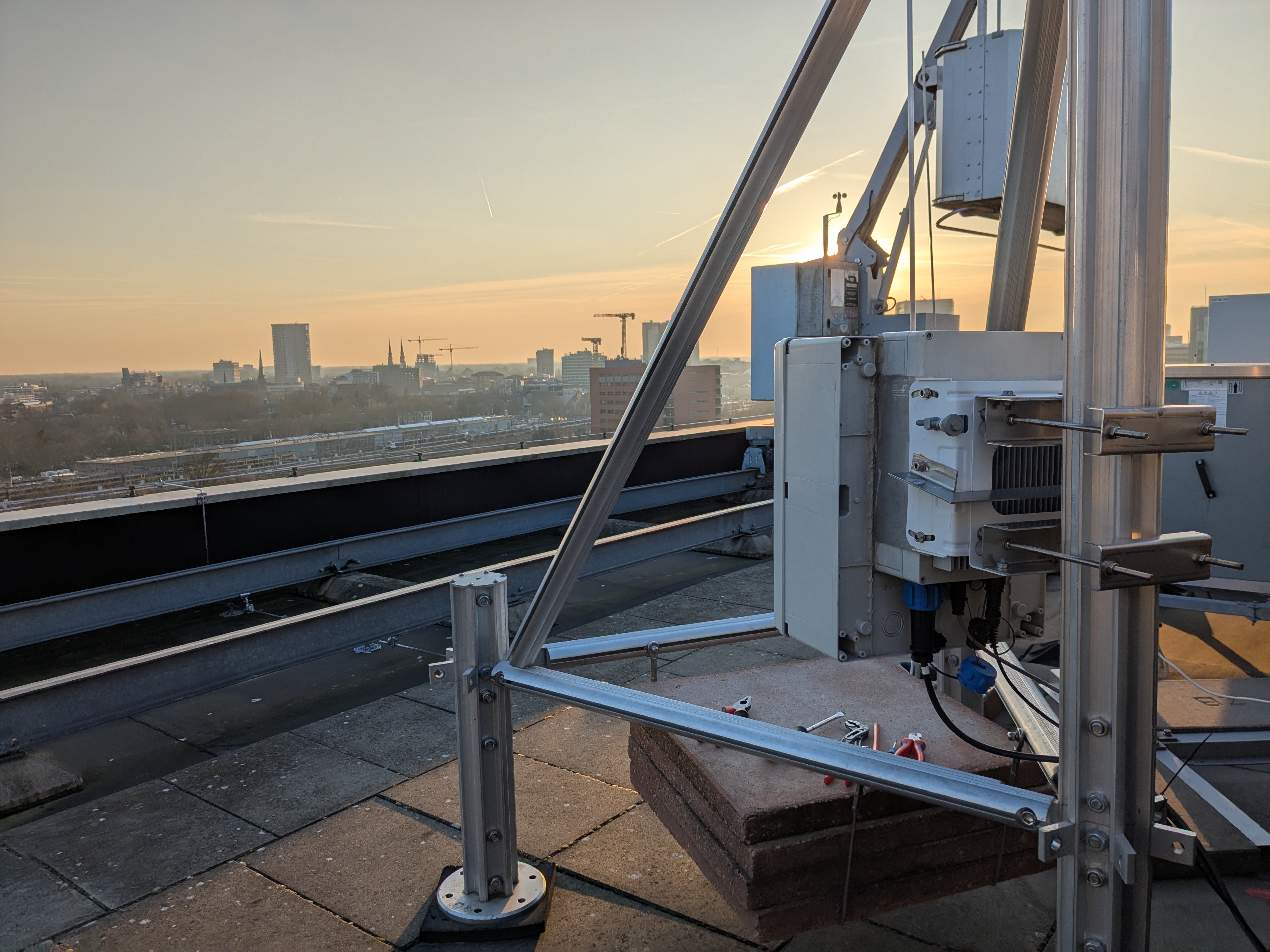
That 4.6 km path is now the Reid Photon loop: a permanent link between the Flux building at TU/e and High Tech Campus 37. It measures wind, rain, temperature and scintillation. A free-space power meter separates atmospheric loss from system performance, and a radio link on the same path lets us run hybrid and routing experiments.
What are the honest limitations of FSO?
I spent part of the talk on what FSO cannot do, because operators need to hear it from us first.
Fog is the big one. Heavy attenuation can reach several hundred dB per kilo meter, and no link budget beats that. So fog has to be handled by the network: a mesh that routes traffic over the fastest available path, not the shortest one. Rain, by the way, does not affect an FSO link the way it affects microwave.
Turbulence causes fades of a few milliseconds. Optical phased array control reduces them, but not to zero, so extreme cases still need a route around.
Every link is a trade-off between speed, availability and distance, and the local environment sets the balance.
Why does FSO fit in the network anyway?
- Defense adds a fourth axis to that trade-off. If radio is jammed, or if transmitting makes you a target, a highly available link that can be detected is worth less than a slightly less available link that cannot be detected.
- The trade-off is no longer informal. ITU-T Recommendation G.641, approved on 29 November 2025, sets out specifications for terrestrial FSO links, covering both the free-space interface and the fiber interface. That means availability for an FSO link can now be described in the same terms carriers already use for the rest of their network.
- Hybrid FSO plus radioworks today. Falling back to radio costs roughly a factor of 100 in capacity,but it keeps the link up. The switch can be made on statistics before the fade,not after the loss, and the degradation can be signaled upstream so the networkrebalances on purpose.
This is the same idea we explored in Why Optical Communication Will Complement, Not Replace, Fiber.
What else can an optical link carry besides data?
A modern network carries more than bits. Our Eindhoven link sits next to the QDNL quantum testbed: four nodes with commercial quantum key distribution (QKD) and key management, plus dark fiber on the same route already running QKD.
Precise time has the same problem as everything else: it stops where the fiber stops. White Rabbit, now the High Accuracy profile of IEEE 1588-2019, gives sub-nanosecond accuracy and picosecond precision over fiber. Past the last fiber, the default is GNSS, which can be jammed and spoofed. A rail crossing, ariver, a missing permit or a forward site is exactly the kind of gap an optical link can close.
The question I left the room with
“Where fiber cannot go, FSO is not a competitor. It is the answer.”
I ended with an open question, and I would like to hear your answer too: when the link is gone, what stops the failover path from taking the network with it?
If you are working on that problem, or on any gap your fiber cannot reach, get in touch with our team.